At the beginning of the year many classrooms create Essential Agreements - a class consenus that will guide the behavioural expectations throughout the year. At best these are student centered (and led) notions that are meaningful and real. At worst they are a hastily put together list of rules that a teacher expects students to abide by.
These can be an important product for a classroom. They make a statement about the sort of culture that everyone feels should be developed throughout the year. My teaching partner this year in Grade Five (along with others from previous years and schools also), and I felt that this was important enough to spend at least a week on in class. Below is the outline of what we tried this year. So far it has worked, but we might change some things for next year.

 Provocation:
This is a popular video that I'm sure has been shown many times in many different classrooms, workshops and offices. Nonetheless, it contains many underlying themes and messages that can be very useful to tune into. Below are some of the answers that our students came up with (although there are many more that could also be raised).
It hooked the students into thinking about the types of behaviours that the PYP and inquiry based classrooms encourage.
 The Dot Game: This is a game that I played at a workshop about Group Dynamics. Everyone pulls a piece of paper out of a hat that is either blank or has a dot on it. There are less dots than non-dots. The game has a few simple rules: Non dots must tell the truth. Dots can choose whether to tell the truth or lie. The aim of the game is to form the biggest group of non-dots possible before the time is up. If a group has just one person in there that is a dot then the entire group is out of the game. Once the time runs out, each group reveals how many members they have and any dots can reveal themselves and see how many groups they managed to knock out.
 The game reveals many different social lessons: establishing
the truth can be difficult, whether reputations count, trust, faith, should you always believe the people that
you’re working with? Are there hidden agendas? Alliances/cliques, the importance of listening to other
ideas, irrational exclusion, the difficulty of making decisions without the facts
or data to back it up, the importance of a sense of belonging. This game is also a good platform from which to raise the important beliefs about how we should treat each other.
The game reveals many different social lessons: establishing
the truth can be difficult, whether reputations count, trust, faith, should you always believe the people that
you’re working with? Are there hidden agendas? Alliances/cliques, the importance of listening to other
ideas, irrational exclusion, the difficulty of making decisions without the facts
or data to back it up, the importance of a sense of belonging. This game is also a good platform from which to raise the important beliefs about how we should treat each other.

 Freyer Model: Another task we ask the students to complete is using a Freyer Model to help define each element of the Learner Profile in order to come up with a definition that is meaningful for the students. Although its difficult to read, I've included an example from the 'Inquirer group' for this year. I've also used this organiser with Grade Three classes but haven't tried with any students younger than that. I've found that it helps the students to make stronger connections with what we're asking them to model. If students don't know what it is they're aiming for then there's little chance of them achieving it. That's also a metaphor for teaching in general, I believe.
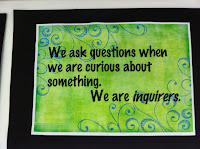
So, below are our Essential Agreements for this year. They took just over a week to develop and I think the students have a solid grounding in what they stand for, and will continue to build meaning throughout the year.


These can be an important product for a classroom. They make a statement about the sort of culture that everyone feels should be developed throughout the year. My teaching partner this year in Grade Five (along with others from previous years and schools also), and I felt that this was important enough to spend at least a week on in class. Below is the outline of what we tried this year. So far it has worked, but we might change some things for next year.


This is a popular video that I'm sure has been shown many times in many different classrooms, workshops and offices. Nonetheless, it contains many underlying themes and messages that can be very useful to tune into. Below are some of the answers that our students came up with (although there are many more that could also be raised).
It hooked the students into thinking about the types of behaviours that the PYP and inquiry based classrooms encourage.
 The Dot Game: This is a game that I played at a workshop about Group Dynamics. Everyone pulls a piece of paper out of a hat that is either blank or has a dot on it. There are less dots than non-dots. The game has a few simple rules: Non dots must tell the truth. Dots can choose whether to tell the truth or lie. The aim of the game is to form the biggest group of non-dots possible before the time is up. If a group has just one person in there that is a dot then the entire group is out of the game. Once the time runs out, each group reveals how many members they have and any dots can reveal themselves and see how many groups they managed to knock out.
 The game reveals many different social lessons: establishing
the truth can be difficult, whether reputations count, trust, faith, should you always believe the people that
you’re working with? Are there hidden agendas? Alliances/cliques, the importance of listening to other
ideas, irrational exclusion, the difficulty of making decisions without the facts
or data to back it up, the importance of a sense of belonging. This game is also a good platform from which to raise the important beliefs about how we should treat each other.
The game reveals many different social lessons: establishing
the truth can be difficult, whether reputations count, trust, faith, should you always believe the people that
you’re working with? Are there hidden agendas? Alliances/cliques, the importance of listening to other
ideas, irrational exclusion, the difficulty of making decisions without the facts
or data to back it up, the importance of a sense of belonging. This game is also a good platform from which to raise the important beliefs about how we should treat each other.

 Freyer Model: Another task we ask the students to complete is using a Freyer Model to help define each element of the Learner Profile in order to come up with a definition that is meaningful for the students. Although its difficult to read, I've included an example from the 'Inquirer group' for this year. I've also used this organiser with Grade Three classes but haven't tried with any students younger than that. I've found that it helps the students to make stronger connections with what we're asking them to model. If students don't know what it is they're aiming for then there's little chance of them achieving it. That's also a metaphor for teaching in general, I believe.
So, below are our Essential Agreements for this year. They took just over a week to develop and I think the students have a solid grounding in what they stand for, and will continue to build meaning throughout the year.


